Showing posts with label orthodontics. Show all posts

Wednesday, March 1, 2017

My Daughter's Orthodontics - Three Year Update

I've received a few requests lately to post an update on my daughter's journey with her orthodontic treatment.  

My daughter, Alina, is almost 10 years old, and she's been using an orthodontic appliance for nearly 3 years. We started Alina's orthodontic treatment early so that we could make the most of her growing years. Rather than using braces, which are well known to not work very well in the long-term, we are using an orthodontic appliance designed to stimulate the palate and jaw to grow larger.

Despite a nutrient-dense diet, Alina's palate and jaw did not naturally develop large enough to accommodate her adult teeth. After researching alternatives to braces and talking with an excellent pediatric dentist who specializes in developmental orthodontics, we decided to use a plastic myofunctional appliance made by Ortho-Tain.


How Alina Uses Her Orthodontic Appliance


Alina wears her Ortho-Tain orthodontic appliance every night while she sleeps. Because we started her treatment early, she does not need to wear the appliance during the daytime at all (whereas if we had waited a few more years before starting, she would have needed to wear it at night as well as for a few hours in the daytime).  Alina tries to remember to bite down hard on her appliance a few times whenever she puts it in her mouth, to strengthen the muscles in her mouth and jaw and further encourage her palate to enlarge.

Alina has been very cooperative with this whole process and has done a fantastic job of wearing her appliance. Her orthodontist is very pleased with her progress and gives her all the credit for being the one to do the work of wearing the appliance and following his instructions.

Our Results From Three Years of Treatment


Over the course of her orthodontic treatment, Alina has progressed through three sizes of orthodontic appliance. This means that her palate and jaw have grown significantly so that she was able to progress to increasingly larger appliances. Currently, Alina has lost 8 baby teeth.  Based on the size of her adult teeth, the appliance Alina is currently using may be the last one she needs (but we will know more when she loses more of her baby teeth).


And now for the pictures!

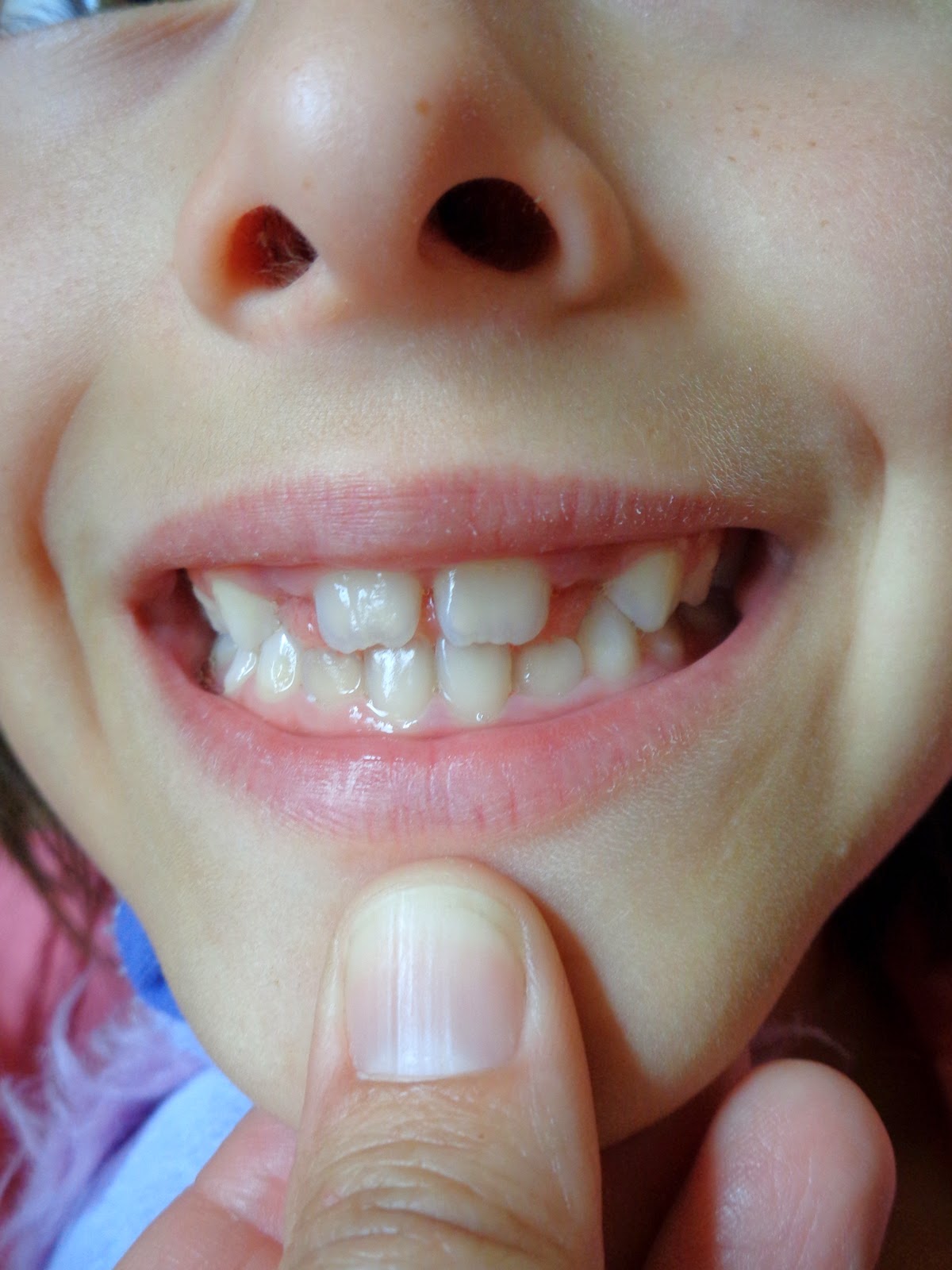
Pre-treatment (April 2014) - Alina's baby teeth have no space between them (minus the one spot where she is missing a tooth)


February 2017 - Her beautiful smile, after almost 3 years of orthodontic treatment

There is more space for her adult teeth on the bottom now compared to in the last update I posted
There is plenty of room for all of her adult teeth thus far

For information about our journey into orthodontic care, check out the rest of the articles in this series:  


Have you tried any alternatives to conventional orthodontics? What were your results?

Thursday, May 21, 2015

My Daughter's Orthodontics - One Year Update

Last year I wrote a series of posts about my daughter's orthodontics and why we are not using conventional braces for her teeth.  It has now been one year since she started using her orthodontic appliance, so I wanted to share our results thus far. My daughter Alina is currently 8 years old and is in the age of "mixed dentition," meaning she has some adult teeth as well as some baby teeth.


How Does the Appliance Work?


Alina is using a one-piece plastic myofunctional appliance made by Ortho-Tain. This appliance is
encouraging Alina's palate and jaw to grow so that there will be plenty of space for her adult teeth.

Alina wears her Ortho-Tain orthodontic appliance every night while she sleeps. Because we started early, she does not need to wear the appliance during the daytime at all (whereas if we had waited a few more years before starting, she would have needed to wear it at night as well as for a few hours in the daytime).

Alina has been very cooperative with this whole process and has done a fantastic job of wearing her appliance.  Her (wonderful) orthodontist is very pleased with her progress and gives her all the credit for being the one to do the work of wearing the appliance and following his instructions.

Our Results From One Year of Treatment

Over the last year, Alina has progressed through two sizes of orthodontic appliance. This means that her palate and jaw have grown enough to need to increase the size of her appliance!

By the time she had been using her appliance for six months, her minor cross-bite was corrected so that her top and bottom teeth now line up correctly. 

And now for the pictures!

Pre-treatment (April 2014) - Alina's baby teeth have no space between them (minus the one spot where she is missing a tooth)


After one year of treatment (May 2015) - Alina has currently lost 8 baby teeth. She has plenty of space for her new top adult teeth.


(May 2015) Alina's teeth no longer have a cross-bite.

(May 2015) There is still some minor crowding with her bottom teeth, but considering that there are 4 adult teeth where there were previously smaller baby teeth with no space whatsoever, you can tell that her bottom jaw has also expanded.  


Have you tried any alternatives to conventional orthodontics? What were your results?

Wednesday, May 13, 2015

The Importance of High-Vitamin Butter Alongside Cod Liver Oil

Nutrients in Butter and Cod Liver Oil Work Synergistically


Photo from Nutrition and Physical Degeneration

In Weston Price's research into Nutrition and Physical Degeneration, he found that the diets of traditional people contained much higher nutrient-content than modern diets.  For instance, traditional diets contained ten times the amounts of Vitamin A and D present in modern diets.  The higher nutrient-content led to people with robust health and virtually no cavities, heart disease, or cancer. One easy way to boost the amount of nutrients in our diets is through the use of superfoods such as extra-virgin cod liver oil, which is a nutritional powerhouse providing Vitamins A and D, plus Omega 3's, DHA, and EPA.

Weston Price found that cod liver oil worked synergistically with high-vitamin butter. Price wrote of controlling and preventing cavities through the following:
"The program that I have found most efficient has been one which includes the use of small quantities of very high vitamin butter mixed in equal parts with a very high vitamin cod liver oil... When this butter oil is mixed in equal parts with a very high-vitamin cod liver oil, it produces a product that is more efficient than either alone...The quantity of the mixture of butter oil and cod liver oil required is quite small, half a teaspoonful three times a day with meals is sufficient to control wide-spread tooth decay when used with a diet that is low in sugar and starches and high in foods providing the minerals, particularly phosphorus. A teaspoonful a day divided between two or three meals is usually adequate to prevent dental caries and maintain a high immunity; it will also maintain freedom from colds and a high level of health in general. This reinforcement of the fat-soluble vitamins to a menu that is low in starches and sugars, together with the use of bread and cereal grains freshly ground to retain the full content of the embryo or germ, and with milk for growing children and for many adults, and the liberal use of sea foods and organs of animals, produced the result described."
It is clear that, to get the most benefit from taking cod liver oil, the nutrients in high-vitamin butter should be consumed alongside cod liver oil.

My Family's Experience with Butter Oil


My family stopped taking fermented cod liver oil (FCLO) years ago because of digestive and flavor issues. Back when we were still using FCLO, my family tried taking high-vitamin butter oil along with our cod liver oil, but we had a hard time with the flavor.  The butter oil had a very strong smell and flavor that I found to be unpleasant; my toddler daughter did like the butter oil, but my husband and I could never get ourselves to take it with any regularity.  At that time, I gave up on the idea of having butter oil, and just focused on liberally using high-vitamin butter (usually on toast or waffle) whenever we took our dose of cod liver oil.

For nearly a year now, we have been using extra-virgin cod liver oil (EVCLO), which we aim to take a couple times a week. EVCLO has such a light, pleasant taste that it is no chore to take it regularly. Thus far, I have been continuing to rely on high-vitamin butter to enhance the benefits of the cod liver oil.  However, recently Corganics sent me a complimentary bottle of their extra-virgin butter oil to try.

I opened the extra-virgin butter oil with the expectation that it would have the same strong and somewhat offensive smell and taste as the butter oil I tried years ago, but I was in for a surprise. Extra-virgin butter oil has a pleasant smell that reminds me of the smell of homemade popcorn, and it tastes like unsalted butter.  I like to add a tiny pinch of salt or dab of raw honey to the butter oil and that makes the taste truly fantastic. Both of my children enjoy the flavor of extra-virgin butter oil and like taking it along with their EVCLO.

We will still be using high-vitamin butter liberally, but especially for those times of year when the butter from the store is on the pale side, it will be a pleasure to supplement with extra-virgin butter oil to make sure we are getting the most benefit from our extra virgin cod liver oil.


What are your experiences with butter oil? Do you take cod liver oil and butter oil together?


Affiliate Disclosure - Links to Amazon and Corganic are affiliate links. If you use these links, your price remains the same, but I earn a small commission. Thanks for supporting this site!

Thursday, August 28, 2014

Changing Facial Growth by Changing Oral Posture

The following is a guest post by Brian Hockel, DDS. After I wrote my post about Alternatives to Conventional Braces, Brian contacted me to inform me about an orthodontic method called Orthotropics®. Because Orthotropics® is so relevant to the topic of using orthodontics to encourage facial growth, I asked Brian to write a guest post about it.

When the facial growth of a child is not keeping up with the genetic potential, both jaws tend to be down and back from their ideal positions in the face. The appearance and the airway function are both affected. This isn't really caused by genetic factors so much as by environmental factors - specifically the posture of the mouth when at rest. Normal mouth posture is: lips together, teeth together in or near light contact, and the tongue firmly against the palate from front to back. When this optimal posture is present, the face will grow forward horizontally, as opposed to downward vertically. What's more, the airway will be more open, the teeth will be straight, and the teeth will have plenty of room! Historically, the problems of too much vertical growth, insufficient room for all 32 teeth (even the wisdom teeth), and the small airways which are prone to sleep apnea are ALL more recent developments. Before the Industrial Revolution, these problems were mainly limited to the aristocratic classes whose food was more refined and cooked. It is also thought that the move away from on-demand breast-feeding and the use of mushy baby food, bottles and pacifiers also contribute to the development of poor oral posture and muscle tone.


This is where Orthotropics® comes in. The goal of Orthotropics® is both to improve oral posture and function, and to convert adverse vertical growth of the face into optimal horizontal growth. This is good for appearance, good for the jaw joints, and especially good for the airway. John Remmers, MD, the sleep specialist who coined the term, "Obstructive Sleep Apnea" (OSA) said that it is a structural disease, and that if the jaws grew to their proper position in the face we would not have the disease. There's lots of other science to support this.

Appliances used for Orthotropics® (either the Biobloc or the Adapt-LRG) are very different from pre-formed or custom Functional Orthodontic Appliances. The Functional Appliances attach the lower jaw to the upper in the often misguided hopes that the lower jaw will move forward.This would include all appliances, pre-formed or custom-made, which bring the lower jaw forward by means of connecting together the upper and lower teeth/jaws, allowing a "head-gear," or pulling backward, effect on the upper teeth/jaw. This isn't to say that Functional Appliances appliances won't work to straighten teeth. They can actually do that very well. But the cost of straight teeth using these appliances is often an adverse reciprocal effect of pulling back on the upper jaw and teeth. And the result of such movement can be a risk to the airway - a risk that many doctors refuse to take. Research and experience both show that these appliances risk pulling the upper jaw even further back from its (most likely) already-too-far-back position. This only compounds the original problem, and does not address either the underlying cause of the adverse growth (rest oral posture) nor the resulting structural damage. If the lower jaw comes forward with Functional Appliances, it is a minimal amount, and the upper is sadly pulled back in a way that ultimately limits the potential for forward movement of the lower jaw - even if these appliances would bring it forward. In contrast, Orthotropics® treatment brings both jaws forward when the child fully cooperates.

Orthotropics® treatment uses the appliances as only a part of the overall treatment regimen. Remember, the goals of Orthotropics® are twofold: modify the skeletal structure AND optimize the oral posture. Accomplishing these goals encompasses much more than simply a discussion of the appliances.

Orthotropics® is among the most difficult treatment options because it requires serious cooperation on the part of the child. It's also a challenge for the parents. I know, having done it for seven of my eleven kids. For example, the child must wear an appliance that guides his jaw into a correct position, without forcing him or her to do so. It is by voluntary formation of a habit that the child learns to hold the closed-mouth posture. Except for eating, brushing, most sports, and singing, the teeth should stay in contact. Even while speaking, the habit of keeping the teeth together must be formed. So it's not going to ever catch on as the "next greatest thing," especially when the motivation of many practitioners is to minimize necessary doctor time.

Even still, thanks to the teaching efforts of Dr. Bill Hang (www.facefocused.com), Orthotropics® has not, and hopefully will not, die out. Dr. John Mew of England is the originator of the principles and the practice of Orthotropics®. He and his son Mike teach the technique in London and around the world, and Mike has put together the website www.orthotropics.com. Almost everyone you see in the North American map of practitioners on the website for our North American group, the NAAFO, (www.orthotropics-na.org) was trained by Dr. Hang. The Biobloc is the name of the training appliance developed by Dr. Mew that is used most commonly, but a newer appliance called the Adapt-LGR has recently been introduced by Dr. Hang. There's no magic wire in any of the appliances, and the principles can be applied without having to use only certain appliances. Until the Adapt-LG, however, no appliance beside the Biobloc has fit the requirements.

Dentists and orthodontists might be misled into thinking that, if they only order the right appliance, they will be able to do Orthotropics®. This would be a huge mistake, as extensive training is required to avoid the many "beginner" mistakes that would follow such an approach. Many doctors have done exactly that over the past forty years that John Mew has taught Orthotropics®.

Before the ages when Orthotropics® is appropriate, and after the age when it's no longer possible, there are few alternatives to accomplish similar goals. Breathing and Myofunctional Therapy are options that can help. While the British practitioners say, "Eight is too late," most practitioners treat until later than that. By the time a child is ten, eleven or twelve, the ability to cooperate begins to diminish exponentially, and the treatment results are often not rewarding enough to justify the heroic efforts required. If sleep apnea is present beyond this point, surgical interventions may be the only way to optimally position the jaws in the face and eliminate the airway restriction. Given that alternative, the challenges and rewards of Orthotropics® are often the choice of motivated parents and their children.

Brian Hockel, DDS
www.hockel.com

Wednesday, July 30, 2014

Selecting an Orthodontist or Dentist, and Our Rapid Results

This post is fourth in a series about alternatives to conventional orthodontics. 

In the other posts of this series, I talked about why my 7-year-old daughter needs orthodontics, why we're not using conventional braces, and some alternatives to conventional braces. Now I'll share our experiences thus far.


Finding the Right Dentist

We do not have any dentists or orthodontists locally that use either lightwire or plastic myofunctional appliances to encourage growth of the dental arches. Using the American Academy of Gnathologic Orthopedics website, I was able to find a few prospective dentists about 220 miles away from our home, in Albuquerque NM.

One thing that was important to me was finding a practitioner who would be okay with our decision to not expose our daughter to X-rays. We also wanted to find a dentist/orthodontist who made our daughter feel at ease so that she would not dread going to the dentist.We learned just how important it was to interview different care providers, as the two practitioners we met with were completely different.

Two Completely Different Dentists

We met with an orthodontist who told us that he knew better than we did about the X-rays and that we would have to do them no matter what our reasons for not wanting them.  That same orthodontist also treated my daughter almost as a non-human entity. He ignored her completely at first, just talking to my husband and myself. He told us that he could accomplish the same thing with either a Crozat or braces, which shows that he really had no idea of the differences between the two methods.  And then he proceeded to start manipulating my daughter's head and mouth without talking to her or asking her permission. She was extremely uncomfortable with this dentist, as evidenced by her stiff-as-a-board posture and grabbing my hand in a death grip while the dentist inspected her mouth.

The other practitioner we met with was a pediatric dentist named Dr. Hess. Our experience with Dr. Hess was completely different than our awful experience with the orthodontist. First and foremost, Dr. Hess engaged our daughter in a conversation about unicorns (one of her favorite animals) and he had a very natural manner that set her at ease. Regarding X-rays, Dr. Hess said that although he would like to have them, he would also respect our decision to not have X-rays so long as we signed a waiver. Dr. Hess was very experienced with using appliances that encourage jaw growth, such as Crozats and plastic myofunctional appliances.  And then he started talking to me about the importance of breastfeeding in developing proper oral habits, and about the research of Weston A. Price.  You can imagine that at this point I knew we had found the right dentist!


My Daughter's Orthodontic Appliance

I was originally interested in getting a lightwire appliance for my daughter, but after discussing the options with Dr. Hess, we decided to use an OrthoTain plastic myofunctional appliance instead.  This option is terrific for us because it allows us to have several months between in-office appointments (since we live so far away), with just some short Skype appointments in between as needed. 


Results Already!

My daughter started using her OrthoTain appliance just 2&1/2 months ago. While we were still getting into the routine of using the appliance, and not yet being terribly consistent with it,we were pleasantly surprised to see that after one month we could already observe more space between our daughter's top teeth.
Before Treatment - There is no space at all between her upper teeth (the space on the bottom is where a baby tooth has been lost).
After 3.5 weeks of Treatment - There is a new space between two of her upper teeth.

After 5 weeks of treatment - There are spaces on both sides of her upper middle teeth (this was just prior to her losing her top two middle teeth, which is why one of them looks slightly pushed backwards).

After 11 weeks of treatment - Now my daughter has lost her two upper middle teeth, and an additional bottom tooth.  There is now plenty of space for her new top teeth that are growing in!

At my daughter's recent in-office follow-up appointment, we learned that her mild cross-bite has already been remedied through the use of her orthodontic appliance. We are looking forward to seeing even more space develop in her upper and lower dental jaws.

Sunday, July 6, 2014

Alternatives to Conventional Braces

This post is the third in a series about alternatives to conventional orthodontics. 
image from orthotain.com

Okay, so my 7-year-old daughter needs orthodontics for her crowded teeth, and we're not using conventional braces because I want her to have more than just straight teeth. I want to actually encourage her dental arches to grow so that her teeth have plenty of space.

Orthodontic Appliances That Encourage Jaw Growth

I have learned of several different orthodontic options that can encourage the dental arches to grow, rather than just straightening the teeth. Because these options cause the bones to grow to accommodate the teeth, there is not a risk of orthodontic relapse like there is with braces. All of these appliances have the additional advantage that they can be used by children as young as 5 years old.

Lightwire Appliances

Image courtesy of AAGO
These include the original lightwire appliance, called Crozat, which was developed in the 1920's, as well as more recently-developed appliances such as Advanced Lightwire Functionals (ALF) and Kernott Universal.  All of these lightwire appliances are made with a flexible, thin-diameter wire that is formed into a removable appliance.  These appliances combine function (chewing, swallowing, etc) along with light forces on the teeth, both of which encourage the dental arches to grow.

The lightwire appliances have the advantage that they are not very obvious when being worn, and may even go completely unnoticed by others. One disadvantage of the lightwire appliances is that the wire can sometimes become damaged during insertion or removal.

A good website for finding practitioners that use lightwire appliances is the American Academy of Gnathologic Orthopedics. ALF practitioners can be found on the ALF Orthodontics Website.

Image courtesy of AAGO


Plastic Myofunctional Appliances

image from commons.wikimedia.org
Plastic appliances that encourage dental arch growth include the original OrthoTain (developed in the 1960's) as well as the MyoBrace. Just as with the lightwire appliances, the plastic myofunctional appliances work through correcting the function (chewing, swallowing, etc) along with light forces on the teeth that encourage dental arch growth.  Plastic myofunctional appliances are typically worn at night as well as for several hours during the day.

Plastic myofunctional appliances have the advantage that they are not custom-made for each patient; rather they are preformed in specific sizes. They do not have the potential for damage like the lightwire appliances do.  One disadvantage of plastic myofunctional appliances is that they are bulkier than lightwire appliances, so they are more obvious when being worn.

I have not been able to find a good website that provides a directory of dentists/orthodontists that use plastic myofunctional appliances.  However, my daughter's dentist, who I found through the American Academy of Gnathologic Orthopedics site, does use plastic myofunctional appliances as well as lightwire, so that site might be a good place to start.
image from orthotain.com


What's Next?

In my final post of this series, I will detail our experiences in finding a suitable dentist, our experiences thus far with using an orthodontic appliance, and some pictures of the results we have experienced.


Other Articles in This Series

My 7-Year-Old Needs Orthodontics! EEK! 
Why We're NOT Using Conventional Braces
Alternatives to Conventional Braces  
Selecting an Orthodontist or Dentist, and Our Rapid Results  
My Daughter's Orthodontics - One Year Update 
My Daughter's Orthodontics - Three Year Update

Do you have any experience with non-conventional orthodontic options? 

Saturday, May 31, 2014

Why We're NOT Using Conventional Braces

This post is the second in a series about alternatives to conventional orthodontics. 

My 7-year-old daughter needs orthodontics.  The conventional approach would be to wait until she
gets older, then use braces to straighten her teeth. Some orthodontists would even recommend extracting some of her teeth to make space for the remaining teeth to be straightened.


Problems with Braces

The main reasons why we are not starting with braces are:
  • Braces do not work in the long term. My husband had braces as an adolescent. At the end of using braces, his teeth were straight. However, now as an adult, his teeth are slowly moving back to their original positions. So the braces made them look better for a time, but in the end they are reverting back to being crooked. This is a well-known phenomena, known as orthodontic relapse.  Nowadays it is a common recommendation that retainers need to be used for the rest of life after braces, to prevent relapse of the teeth into their original positions.
  • Braces do not go to the root of the problem, which is that the jaw is not large enough to accommodate the teeth. Rather, braces just seek to straighten the teeth to make them look better. When there is not enough room for all of the teeth, perfectly sound teeth are often removed prior to the installation of the braces. I want my daughter to be able to keep all of her teeth!
  • With braces, we would need to wait until my daughter was nearly done growing to get started. That means that we would have missed out on many opportunities for jaw growth.  


Thinking Beyond Just Straight Teeth

Yes, straight teeth look better than crooked teeth, but there is a larger goal than just having straight teeth. Years ago, when I read Weston A. Price's monumental book, Nutrition and Physical Degeneration, one of the cases that made a huge impression on me was the story of a sixteen-year-old boy who had Down's Syndrome (which was referred to as being mongoloid during Price's time).

"This boy at the age of sixteen was infantile in many of his characteristics and developments... he had a mentality of about four years... He played on the floor with blocks and with rattles like a child. ... I determined to widen his arch by moving the maxillary bones apart about one-half inch. The position of his teeth before the moving of the bones is shown in Fig. 126.
"...With the movement of the maxillary bones laterally, as shown progressively in Fig. 126, there was a very great change in his physical development and mentality. He grew three inches in about four months. His moustache started to grow immediately; and in twelve weeks' time the genitals developed from those of a child to those of a man, and with it a sense of modesty. His mental change was even more marked.... In a few weeks' time he passed through stages that usually take several years. At first, he got behind the door to frighten us; later, he put bent pins on chairs to see us jump when we sat down, and finally he became the cause of a policeman's coming to the office from where he was conducting traffic on the corner below to find who it was squirting water on him when his back was turned. He developed a great fondness for calling people over the telephone, wanted to borrow my automobile to take his mother for a drive, and with his arm caressingly about the shoulders of one of the secretaries, invited her to go with him to a dance. All this change developed in about twelve weeks.   

FIG. 125. These views show physical changes in the mongoloid type due to movement of maxillary bones to stimulate the pituitary gland in base of brain. Left, front and side view before, center, front and side view in thirty days. Right, front and side view six months after. Aged sixteen, infantile before, adolescent after operation. (Image from Project Gutenberg)


 "A most remarkable event happened in connection with this procedure. He lived in another city, and so, while with me, stayed in a boarding house at a little distance from my office in order that he might have frequent, and almost constant attention. On his return to his home town, his efficiency had increased to such an extent that his mother could send him with the money to the grocery store with the order for the day's groceries, and he could bring back the right change and could tell when it was correct. He could also come alone to me ninety miles by railroad and make two changes of trains and the various transfers on the street cars of the city with accuracy and safety."

FIG. 126. These x-ray pictures show the position of the teeth before operation to move maxillary bones; and progessively, by the dates shown, the widening of the upper arch.... The space was retained with a fixed bridge carrying two additional teeth. (Image from Project Gutenberg)

This case illustrates that the size of the jaw can have a very large effect on the brain.  Because I had read Weston Price's book previously, when I noticed that my daughter's baby teeth were crowded, I knew that I wanted to find a way to help her jaw grow larger.

While my daughter does not show any signs of delayed development, I certainly want to give her every opportunity to grow into her fullest potential. So rather than using braces to just straighten her teeth, I would much rather that my daughter's upper and lower jaw actually grow larger to accommodate her teeth. 

In the next post of this series, I will discuss alternatives to braces that work by encouraging the jaw to grow to make room for the teeth.

Did your teeth experience orthodontic relapse after braces? Have you read Weston Price's Nutrition and Physical Degeneration?

Sunday, May 18, 2014

My 7-Year-Old Needs Orthodontics! EEK!

This post is the first in a series about alternatives to conventional orthodontics.

Things didn't develop perfectly during my first pregnancy.  Through the wonders of a nutrient-dense diet, my daughter Alina was able to survive in the womb with a half-sized placenta, yet we are still working on a few of the problems that resulted from her being nutrient-starved in the womb.

My daughter has a very fine bone structure. Ever since she was an infant, we have struggled with her having a poor appetite and poor weight gain. Early on, I became concerned that her baby teeth were crowded.  There was just enough space for all of her baby teeth, but there was no extra space at all.

Alina at 4 years old
Alina at 2 years old


Alina at 6 years old
I kept hoping that, through eating a nutrient-dense diet, my daughter's palate and jaw would grow larger to accommodate her adult teeth. Through classical homeopathy, we have been able to correct the imbalances in my daughter's appetite and weight gain, but one thing that hasn't changed is the size of her palate and jaw.  You can see in these recent pictures that her jaw structure is very different from her little brother's (and his head is larger than hers despite the fact that he is 3 years younger).


Alina age 7, Ian age 4: You can see that my daughter's baby teeth fit very tightly in her mouth, while her brother has space between all of his teeth.
My daughter started losing her baby teeth last year. Her new adult teeth will not fit into the spaces left by her baby teeth. Alina has lost three baby teeth so far, and only two adult teeth have emerged.  The third baby tooth she lost was not lost due to pressure from a tooth that was ready to emerge in that location. Rather, it was lost due to pressure from an emerging neighboring tooth that will not fit in the space left by the baby tooth.

Yup, she needs orthodontics! And she now has her first orthodontic appliance.


In upcoming posts, I am excited to share with you what I've learned about orthodontic options, why we're not using conventional braces, and how we are actually encouraging my daughter's jaw to grow to accommodate her adult teeth.

Did you have braces as a child? Do your kids need orthodontics?